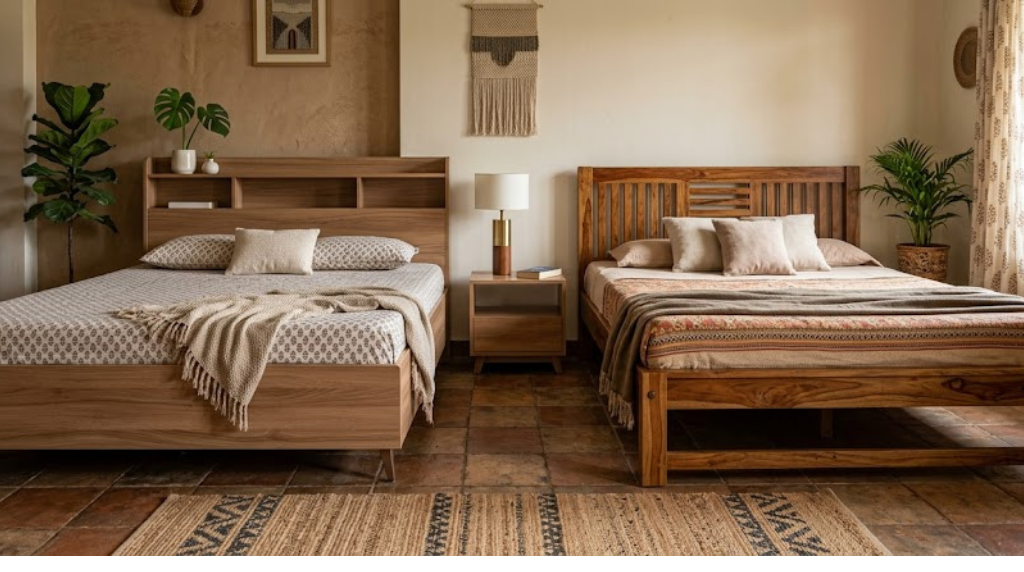
Stop! Don’t Buy a Bed Until You Read This Plywood vs Solid Wood Beds Comparison

Chirag Vekariya
Key Takeaways
- Moisture & Climate: Solid wood expands and contracts during Indian monsoons, while high-grade Boiling Water Proof (BWP) plywood offers superior dimensional stability in humid regions.
- Longevity & Repairs: Solid wood bed frames can last over 30–50 years and can be re-sanded or refinished, whereas plywood beds typically last 10–15 years and cannot be easily re-planed once deep damage occurs.
- Budget vs. Value: Plywood beds provide lower upfront costs and flexible modern designs; solid wood demands higher initial investment but carries heirloom value.
- Termite Resistance: Chemically treated BWR/BWP plywood provides high built-in protection against termites, whereas solid wood requires periodic treatments depending on the wood species (e.g., Teak vs. Sheesham).
Buying a bed is one of the most significant investments you will make for your home. You spend nearly a third of your life sleeping, and in Indian households, a bed frame often doubles as a storage hub, children’s play zone, and central piece of bedroom decor. However, walking into a furniture showroom or browsing online often leaves buyers torn between two popular choices: plywood vs solid wood beds.
Choosing the wrong bed material leads to creaky joints, sagged storage boxes, or termite infestations within a few years. In a diverse climate like India—where humidity swings from torrential monsoons to dry summers—the structural performance of your bed frame depends heavily on its core material.
Below is a detailed, practical comparison covering durability, maintenance, costs, and environmental performance so you can make the right decision for your home.
Understanding the Basics: Natural Timber vs. Engineered Plies
Before comparing structural strength, it is essential to understand how these two materials are manufactured and used in modern furniture design.
What is a Solid Wood Bed?
A solid wood bed frame is constructed directly from natural sawn timber logs without internal composite layering. Popular Indian hardwood species include Teak (Sagwan), Sheesham (Indian Rosewood), Sal, and imported alternatives like Oak or Walnut. Solid wood is prized for its organic grain patterns, high natural density, and structural integrity.
What is a Plywood Bed?
A plywood bed frame is crafted from engineered wood boards created by layering thin sheets of wood veneer glued together with high-strength adhesives under pressure. For furniture, manufacturers use commercial grade (MR), Boiling Water Resistant (BWR), or Boiling Water Proof (BWP) plywood, often finished with decorative laminates or natural wood veneers.
1. Structural Strength and Plywood Bed Durability
When evaluating plywood bed durability, structural load distribution is the primary consideration. A king-sized bed frame must support the weight of the mattress, occupants, and stored items inside hydraulic storage boxes.
- Solid Wood: Hardwoods like Teak and Sheesham exhibit high tensile strength. They can handle heavy point loads without flexing. Joints crafted using traditional joinery (such as mortise and tenon) stay rigid for decades.
- Plywood: Marine-grade BWP plywood offers high cross-directional strength. Because each ply layer runs perpendicular to the adjacent one, plywood resists splitting and warping along the grain.
However, solid wood retains an advantage in fastener retention. Screws driven into solid wood bite deeply into natural fibers. Over 10–15 years, repeated dismantling and reassembling of hydraulic mechanisms can loosen screw holes in lower-grade plywood faster than in solid hardwood.
2. Humidity Performance and Climatic Resistance in India
India's varied climate plays a substantial role in furniture longevity. Atmospheric humidity causes timber to absorb moisture and expand, whereas dry heat causes shrinkage.
- Solid Wood Behavior: Natural timber is hygroscopic. During monsoon seasons in coastal regions like Mumbai or Chennai, solid wood doors and bed drawers may swell and stick. In dry winters, slight hairline cracks along natural grain lines can appear if the timber was not seasoned properly in a kiln.
- Plywood Behavior: High-grade BWP plywood uses synthetic resins like phenol-formaldehyde. This construction prevents the board from expanding or warping, making plywood an excellent choice for modern hydraulic bed frames and under-bed storage drawers in high-humidity zones.
Head-to-Head Comparison: Solid Wood vs Plywood Beds
The table below breaks down the key performance metrics between the two bed frame options:
| Feature / Metric | Solid Wood Bed Frame | Plywood Bed Frame (BWP/BWR) |
| Primary Material | 100% Natural Hardwood Logs | Multi-layered Engineered Plies |
| Average Lifespan | 30 to 50+ Years | 12 to 20 Years |
| Warp & Moisture Resistance | Moderate (Requires proper kiln seasoning) | High (Cross-laminated stability) |
| Termite Susceptibility | Varies (Teak is natural resistant; others require treatment) | High (Factory-treated with anti-termite chemicals) |
| Weight & Portability | Very Heavy | Moderate to Heavy |
| Customization & Finish | Natural stains, carvings, hand polish | Laminates, acrylics, wood veneers |
| Price Point | Premium / High initial investment | Mid-range / Cost-effective |
3. Maintenance Requirements: Solid Wood Bed Maintenance vs Plywood Care
Keeping your bed frame in optimal condition requires different routines depending on the core material.
Solid Wood Bed Maintenance
- Polishing: Solid wood requires re-polishing (PU, Melamine, or traditional wax polish) every 5–7 years to retain its sheen and protect the timber surface from environmental drying.
- Cleaning: Dust with a soft microfiber cloth. Avoid wiping down unsealed wood with dripping water.
- Sunlight Protection: Direct UV exposure over prolonged periods can dry out natural oils and cause surface fading.
Plywood Bed Maintenance
- Surface Cleaning: Since plywood bed frames are typically capped with laminates or veneers, daily maintenance involves wiping surfaces with a damp cloth and mild cleanser.
- Edge Protection: Ensure PVC edge-banding remains intact. Exposed edges can absorb spilled liquids, leading to localized swelling.
- Hardware Care: Periodically check screw tightness on bed hinges and hydraulic lifters.
4. Cost Analysis and Overall Value
When shopping for the best wood for bed frame India choices, upfront price versus long-term value is a key decision factor.
- Upfront Investment: A handcrafted solid Teak or Sheesham bed typically costs 1.5x to 2.5x more than a premium BWP plywood bed frame of equal dimensions.
- Resale and heirloom value: Solid wood beds retain intrinsic material value. They can be sanded down, repaired, or refinished decades later. Plywood beds, while highly functional and durable, lose most of their commercial value once dismantled multiple times or worn at the edges.
For buyers seeking balance, opting for a high-density plywood box structure paired with a solid wood headboard offers an effective mix of stability and natural aesthetics. You can review engineered material costs on the [LINK: Sarathi Innovations product catalog] to compare frame options against your budget.
According to furniture industry research published by the Forest Products Laboratory, cross-laminated timber products display uniform strength distribution along board edges, whereas natural sawn lumber demonstrates higher longitudinal stiffness along the natural grain. Citing these mechanical properties highlights why engineered panels are preferred for flat-pack hydraulic storage designs, while timber remains the standard for decorative legs and posts.
How to Choose the Best Option for Your Home
Use this practical decision matrix to narrow down your choice:
Choose a Solid Wood Bed If:
- You prefer traditional carving, poster beds, or exposed natural timber aesthetics.
- You want an heirloom piece that can be passed down for decades.
- You live in a dry climate with stable humidity levels.
- You rarely relocate or move homes.
Choose a Plywood Bed If:
- You need space-saving hydraulic or box storage built into the frame.
- You want a wide selection of modern laminate finishes, colors, and textures.
- You live in high-humidity or coastal regions subject to seasonal warping.
- You want maximum structural durability at a mid-range price point.
Frequently Asked Questions (FAQs)
What is the primary difference between engineered wood vs solid wood bed frames?
Solid wood is 100% natural sawn timber cut directly from trees, offering high strength and traditional aesthetics. Engineered wood (such as plywood, MDF, or particle board) is manufactured by bonding wood fibers or veneers with adhesives, making it more resistant to warping under humidity changes.
How to check if a plywood bed is termite proof?
Check the grade certification stamped on the sheet. Ensure the manufacturer uses IS 710 certified BWP (Boiling Water Proof) plywood that has undergone factory-level Chemical Preservative Treatment (CPT). Always ask your vendor for a written termite-warranty certificate.
Why does a solid wood bed creak after a few years?
Creaking usually occurs when natural timber expands or shrinks due to seasonal humidity shifts, loosening joint hardware or warping mortise-and-tenon connections. Tightening structural bolts and applying candle wax or lubricant to wood-on-wood joints resolves most noises.
Is BWP plywood better than solid wood for hydraulic storage beds?
Yes. BWP plywood provides flat dimensional stability and high screw-holding strength for large panel areas, making it less prone to sagging or bending under the weight of hydraulic lifting mechanisms compared to wide solid timber planks.
What is the best wood for bed frame India climatic conditions?
For solid wood, Teak (Sagwan) and Sheesham are top choices due to their natural density and oil content. For engineered options, IS 710 Grade BWP Hardwood Plywood is considered the standard for long-term durability in humid Indian environments.
Conclusion
Both plywood and solid wood beds offer distinct strengths depending on your budget, interior style, and local environment. If you value classic craftsmanship, natural wood grains, and multi-generational longevity, investing in a solid timber frame is an excellent path. Conversely, if your priority is modern hydraulic storage, sleek laminate finishes, and resistance to monsoon humidity, a BWP plywood bed delivers superior practical value.
Ready to upgrade your bedroom with custom-crafted, durable furniture tailored to your space? Explore the complete collection of custom bedroom solutions and durable material options at Sarathi Innovations today.