Hospital Interior Design Ahmedabad: Developing Effective Healthcare Spaces

Chirag Vekariya
When you picture a hospital, you probably envision sterile, white hallways, waiting rooms that feel cold and clinical, an environment that leaves one with a sense of discomfort. But in 2026, designing a hospital is much more than just making spaces for medical needs. More recently, attention has turned toward creating environments that promote restorative healing, minimize stress, and create a better experience for not only the patients but also the staff. Enter Sarathi Innovations where we leverage the principles of Evidence-Based Design (EBD) in state-of-the-art medical space planning for healing spaces that make wellness possible, speeds recovery, and strengthens staff performance.
In a medical hub such as Ahmedabad, where private clinics and multi-specialty hospitals are springing up like mushrooms, the design of a hospital is not only about aesthetics but also performance. The service of a planned-out hospital can be understood as nothing less than the functioning of a high-tech machine where every single space, each little detail is designed to contribute for an experience that acquires its peaks on smooth patient journeys, efficient workflows and an overall therapeutic atmosphere.
Experience: The 'First 60 Seconds'
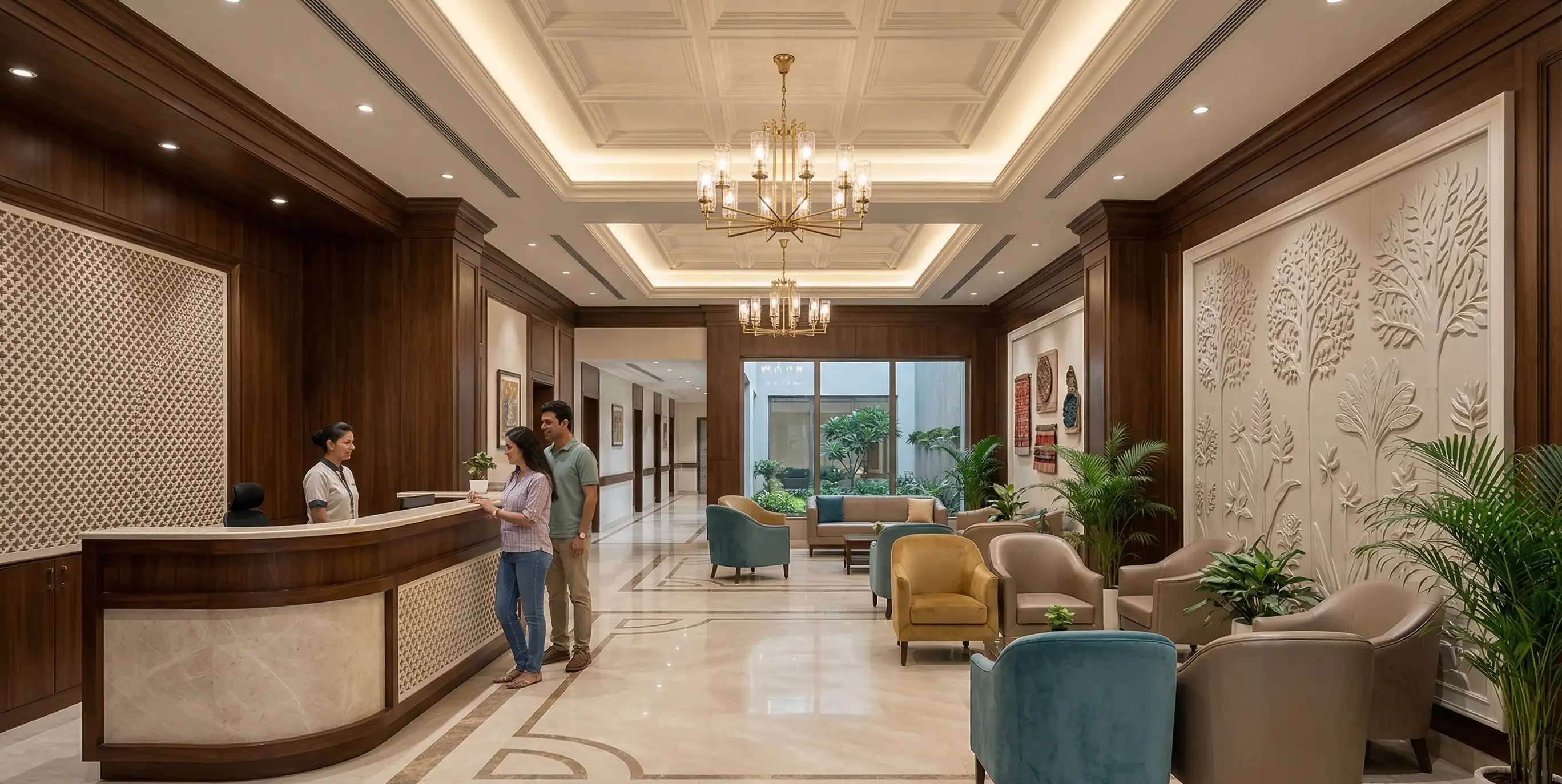
The second a patient enters a hospital and especially if they are sick or injured their surroundings already have an emotional effect on them. A lobby designed to feel like a luxury hotel, with reassuring aesthetics, soft lighting and natural elements, can decrease a patient’s heart rate and drop anxiety levels. In contrast, a cold, sterile lobby can heighten stress and fear uncertainty feelings that may delay healing.
This initial emotional experience is something Sarathi Innovations has not taken lightly. We use design elements to de-stress and calm patients even before they see a doctor. Whether it’s to choose designated soothing colors, comfortable furniture and/or natural light, a patient journey begins the second they walk through the door.
Expertise: The 5 Pillars of Medical Efficiency
As healthcare interior architecture specialists, Sarathi Innovations uses these 5 pillars of medical efficiency to design high-caliber hospitals that expedite patient recovery while minimizing staff fatigue.
1. Infection Control: The Anti-Microbial Core
Infection control is a vital aspect of hospital design. Healthcare-associated bloodstream infections from harmful bacteria and viruses can have devastating consequences. To counteract these issues, Sarathi Innovations has installed seamless, non-porous flooring (like medical-grade vinyl) throughout the hospital. This limits the space and resources available for bacteria to attach and thrive, decreasing the chance of infection.
We also use touchless antimicrobial surfaces for door handles, reception desks and high-traffic areas. By creating these types of clean environments, we protect patients in our hospitals but also make it easier for staff to maintain cleanliness.
2. The 'Golden Hour' Flow
A hospital layout is key to optimise patient care and work efficiency. Saraathi Innovations designs hospitals, focusing on zoning to segregate patient flow from visitor traffic and emergency trolley movement. This lessens the chance of “corridor clogging” and helps ensure that medical workers can move in and out between critical spaces for patient care.
It can provide separate zones for separate functions in emergency care, inpatient rooms and staff areas to avoid confusion and disrupt the delivery of care, particularly in the crucial “Golden Hour” period after a traumatic event.
3. Circadian Lighting & Recovery
It cannot be underestimated how vital light is to healing. Sarathi Innovations uses automated LED systems that mimic sunshine to address patients’ circadian rhythms. Such systems are proven to improve the ability to recover faster, especially among long-time treatment or ICU patients. Natural light balances hormones, enhances mood and promotes better sleep, speeding up the recovery process.
4. Acoustic Privacy: Reducing Alarm Fatigue
“Alarm fatigue,” due to a barrage of beeping and other noises from equipment in intensive care areas, is a problem at many hospitals. Sarathi Innovations solves this issue by creating sound-masking ceilings and “Silent-Call” systems that lower noise levels to prevent staff and patients from feeling overwhelmed. Solution Examples: Noise within a hospital has been shown to impede the healing process.
5. Ergonomics for Healers
A hospital is not only a space for patients, but also where health care professionals spend its long hours working. Sarathi Innovations REVOLUTIONISES nurse station and OT layouts keeping the HEALTH and COMFORT of medical staff as a top priority. This will enable doctors, nurses, and other healthcare professionals to work efficiently and comfortably under ergonomics guidelines during long shifts without a strain on their physical health.
Evidence-Based Design (EBD) in 2026
Evidence-Based Design (EBD): There’s a reason it sounds so official it is pure science on how we plan and design interiors in a healthcare environment. Evidence Based Design (EBD) guidelines utilize research and data to develop designs that yield improved health outcomes. Couple that with their foundation in EBD principles and they apply this to each project optimizing lighting, layout, choosing material to reduce infection risk.” Our designs focus on patient healing, stress reduction, and staff productivity.
The Logistics of Life-Saving: OT and ICU Spatial Planning
Operating rooms (OT) and ICU areas are the most critical spaces in a hospital. Proper spatial planning is essential to ensure that these areas are functional and efficient. Sarathi Innovations incorporates advanced planning techniques for OT and ICU layouts, including integration of oxygen lines, radiation shielding for X-ray rooms, and the careful placement of equipment to ensure quick access during critical moments.
Durability & Compliance
In the healthcare industry, durability and compliance with regulations are paramount. Sarathi Innovations designs hospital interiors that can withstand heavy-duty chemical cleaning for over 10 years without degradation. We ensure that all materials used in our designs meet strict healthcare regulations, guaranteeing that the spaces remain functional, clean, and safe for years to come.
Sarathi Innovations as the Leader in Healing Environments
Sarathi Innovations is a pioneer in creating healing environments for private clinics and multi-specialty hospitals across Ahmedabad. Summary: Hospital architecture is not just about how the building looks from the outside; it is also an important aspect of creating patient healing environments, keeping healthcare staff stress free and fatigue free and improving hospital experience. We get that healthcare design is more than aesthetics and function it’s healing.
Sarathi Innovations Medical Tip: Air Quality and Heat in Ahmedabad
In Ahmedabad’s hot and dusty climate, air quality is one of the biggest threats to hospital efficiency. Dust-borne infections are a major concern in the city’s healthcare facilities. Sarathi Innovations addresses this challenge by designing negative pressure zones and integrating HEPA filtration systems into the false ceiling architecture. This ensures that surgical zones remain 99.9% particulate-free, even during the dustiest summer months.
Medical Design Checklist for Hospital Administrators
When planning a hospital, administrators must consider the following checklist to ensure the success of the project:
- Space Planning: Ensure that patient flow, visitor traffic, and emergency movement are well separated.
- Infection Control: Use seamless, non-porous flooring and touchless antimicrobial surfaces.
- Lighting: Install circadian lighting systems that mimic natural sunlight.
- Acoustic Design: Use sound-masking ceilings and “Silent-Call” systems to reduce noise levels.
- Ergonomics: Design nurse stations and OT layouts with ergonomic considerations.
- Durability: Choose materials that can withstand heavy-duty cleaning and meet regulatory standards.
- Compliance: Ensure that all designs meet healthcare regulations and safety standards.
5 FAQs About Healthcare Interior Design
1. What is Evidence-Based Design (EBD)?
Evidence-Based Design (EBD) is a method of designing healthcare facilities using data and research to create environments that promote better health outcomes, reduce stress, and improve efficiency.
2. How does hospital interior design affect patient recovery?
Hospital interior design impacts patient recovery by creating a calming, healing environment. Elements such as natural lighting, soothing colors, and noise reduction can lower stress and accelerate recovery times.
3. Why is infection control crucial in hospital design?
Infection control is essential to prevent the spread of harmful bacteria and viruses. Non-porous surfaces and touchless systems reduce the risk of cross-contamination and help maintain a sterile environment.
4. How does circadian lighting aid recovery?
Circadian lighting mimics natural sunlight, helping to regulate patients' circadian rhythms. This promotes better sleep, improves mood, and accelerates recovery, particularly for long-term patients and those in the ICU.
5. What is the significance of acoustics in hospital design?
Acoustic privacy is crucial in healthcare environments to prevent “alarm fatigue” and reduce stress. Sound-masking systems and quiet zones help create a peaceful atmosphere, promoting patient recovery and staff well-being.