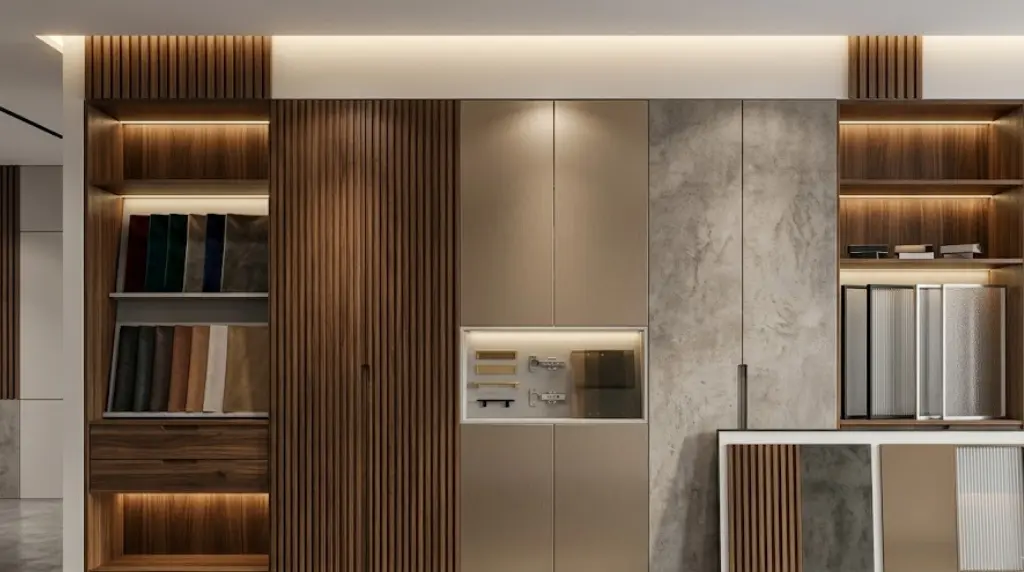
Best Wardrobe Materials: Quick Guide for Indian Homes

Chirag Vekariya
Key Takeaways
- BWR/BWP Plywood is the Top Core Choice: For Indian homes facing high humidity and monsoon moisture, Boiling Water Resistant (BWR) Marine Grade Plywood (IS 710) offers maximum durability and screw-holding strength.
- HDMR Outperforms MDF: High-Density Moisture-Resistant (HDMR) boards provide a smoother, cost-effective alternative to MDF with superior water resistance for interior bedroom wardrobes.
- Finish Defines the Look & Maintenance: High-pressure laminates offer budget-friendly durability, while acrylic finishes provide a high-gloss luxury mirror effect that is easy to clean.
- Hardware & Shutters Need Balance: Heavy materials like thick plywood require high-tensile auto-close hinges to prevent sagging over time.
Building or renovating a home requires making dozens of choices, but selecting the right material for your storage space directly impacts your daily life. A wardrobe is not just a piece of furniture; it is a heavy-use fixture that must withstand daily friction, tropical humidity, and weight loads without warping or sagging.
Over ten years of custom interior manufacturing across India reveal that nearly 60% of wardrobe structural failures stem from selecting inappropriate core materials for local climate conditions. Using low-grade particle board in high-humidity cities often leads to swollen shutters and loose hinges within two years.
This wardrobe material guide breaks down core substrates, exterior finishes, hardware selection, and cost considerations. By understanding these options, you can choose the best wardrobe materials for a durable, elegant storage solution tailored to your home and budget.
Understanding Wardrobe Construction: Carcass vs. Shutters
Before comparing materials, it helps to understand the two main structural parts of a wardrobe:
- The Carcass (Inner Body): The internal frame, shelving, drawers, and back panel. The carcass requires high load-bearing capacity, screw-holding strength, and structural rigidity.
- The Shutters (Outer Doors): The visible front doors (hinged or sliding). Shutters require dimensional stability to avoid bending, along with smooth surfaces for applying decorative finishes.
Selecting the right material for both the core and the finish ensures long-lasting stability and a refined look.
Core Materials: Comparing Substrates for Indian Wardrobes
The core material determines the strength, lifespan, and moisture resistance of your cupboard. Here is how the four main engineered wood options perform.
1. Commercial & Marine Plywood (BWR / BWP)
Plywood is constructed by cross-laminating multiple wood veneers bonded under high heat and pressure.
- Commercial Plywood (MR Grade): Moisture Resistant (MR) plywood handles basic dry-area wardrobes well.
- Marine / BWR Plywood (IS 303 / IS 710): Boiling Water Resistant (BWR) and Boiling Water Proof (BWP) plywood use synthetic phenol-formaldehyde resins [LINK: Indian Standards Institution guidelines for IS 710 plywood]. They offer outstanding resistance to humidity, termites, and heavy weight.
Expert Insight: According to Indian ply manufacturer standards, IS 710 certified BWP plywood absorbs less than 5% moisture after 72 hours of continuous boiling water tests, making it the premier choice for coastal or humid regions.
- Pros: Exceptional screw-holding capacity, high bending strength, long lifespan (15–20+ years).
- Cons: Higher initial cost than engineered boards; requires edge-banding to seal cut edges.
2. High-Density Moisture-Resistant (HDMR) Board
HDMR is an upgraded alternative to traditional Medium-Density Fibreboard (MDF). It is manufactured by combining chips and wood fibers with moisture-resistant resins under high density (over 750 kg/m³).
- Pros: Highly cost-effective, extremely smooth surface ideal for seamless painting or acrylic pressing, zero core voids.
- Cons: Lower screw-re-entry strength compared to plywood; slightly heavier.
3. Medium-Density Fibreboard (MDF)
MDF is produced by breaking down hardwood or softwood residuals into wood fibers and combining them with wax and resin.
- Pros: Budget-friendly, uniform surface, easy to carve for detailed router designs.
- Cons: Susceptible to swelling if exposed to direct water leaks; moderate load-bearing capacity for wide shelves.
4. Particle Board / LDF
Low-Density Fibreboard (LDF) or particle board is made from bonded wood chips and saw shavings.
- Pros: Lowest price point; lightweight for ready-to-assemble flat-pack furniture.
- Cons: Low moisture resistance, poor screw-holding capability after dismantling, short service lifespan.
Core Material Comparison: Plywood vs MDF for Wardrobes
Choosing between plywood vs MDF for wardrobes comes down to balancing strength, budget, and local moisture levels.
| Parameter | BWR Plywood (IS 710) | HDMR Board | MDF Board | Particle Board |
| Moisture Resistance | High (Boiling Water Proof) | High | Low–Moderate | Very Low |
| Screw-Holding Capacity | Superior | Good | Moderate | Poor |
| Bending Strength | Very High | High | Moderate | Low |
| Surface Smoothness | Textured (Requires Sanding) | Ultra-Smooth | Smooth | Requires Laminate Cover |
| Budget Tier | Premium | Mid-Range | Budget–Mid | Economy |
| Ideal Application | Main Carcass & Heavy Shelves | Flat Shutters & PU Paint | Router Design Doors | Temporary Storage |
Surface Finishes: Elevating Your Wardrobe Aesthetics
Once you select your core material, choosing the right outer finish defines the final look, ease of maintenance, and scratch resistance of your custom closet. Let's explore the primary wardrobe finishes in India.
1. High-Pressure Laminates (HPL)
Laminates consist of layered paper and decorative resins pressed under high pressure. They are the most common choice for the best material for cupboards.
- Thickness: 0.8mm to 1.5mm (1mm or 1.2mm recommended for shutters).
- Finishes: Matte, suede, gloss, textured woodgrain, metallic.
- Why Choose: Scratch-resistant, low maintenance, economical, and available in hundreds of colors.
2. Acrylic Finishes
Acrylic panels are high-gloss sheets applied over HDMR or plywood cores.
- Appearance: Delivers a mirror-like high-gloss finish that expands visual space in smaller bedrooms.
- Maintenance: UV-resistant and color-fast, though glossy surfaces may require periodic wiping to remove fingerprints.
- Best For: Contemporary master bedroom wardrobe shutters.
3. Polyurethane (PU) Paint
PU paint is a spray-applied liquid coating that seals the core completely.
- Look & Feel: Available in matte or high-gloss finishes, offering seamless curved edges without visible edge-bands.
- Customization: Unlimited color matching via Asian Paints or ICI Dulux palettes.
- Considerations: Requires professional spray booth execution; higher price point.
4. Natural Wood Veneers
Veneers are thin slices of natural timber mounted onto plywood cores.
- Characteristics: Premium grain aesthetics, unique natural wood patterns, re-polishable.
- Best For: Luxury, classic, or transitional interior styles [LINK: Sarathi Innovations portfolio for luxury home interiors].
Crucial Factors When Picking Wardrobe Materials in India
To choose the best wardrobe materials for your project, keep these four technical factors in mind:
1. Regional Climate & Humidity
Indian summers bring heat, while monsoon months introduce dampness into walls. Always select moisture-resistant core materials like BWR Plywood or HDMR for internal carcass construction, especially against external masonry walls.
2. Door Type: Hinged vs. Sliding
- Hinged Shutters: Need rigid cores (like 18mm Plywood or HDMR) that hold soft-close hinges securely over thousands of opening cycles.
- Sliding Doors: Require tall, anti-warp shutter panels (18mm to 25mm) paired with aluminum stiffener profiles to keep wide doors operating smoothly on tracks.
3. Shelf Span and Load Weight
Longer wardrobe shelves (over 3 feet wide) experience bending stresses under folded clothes and suitcases. Always use 18mm thick Marine Plywood for spans exceeding 900mm to prevent shelf sagging over time.
4. Eco-Friendly Ratings (Formaldehyde Emissions)
Plywood resins release trace gases. Opt for E0 or E1 certified low-emission plywood to ensure healthy indoor air quality in enclosed bedroom spaces.
Budget Planning & Cost Breakdown
Material selection directly drives the total investment required for custom bedroom storage. Below is an approximate cost range for custom wardrobe manufacturing in major Indian metros.
- Economy Tier (₹1,200 – ₹1,600 per sq. ft.):
- Core: Commercial Ply / MDF
- Outer Finish: 0.8mm–1.0mm Basic Matte Laminate
Hardware: Standard soft-close hinges
- Mid-Range Tier (₹1,800 – ₹2,400 per sq. ft.):
- Core: BWR Plywood (IS 710) / HDMR
- Outer Finish: 1mm Premium Textured Laminate or Matte Acrylic
Hardware: Branded soft-close hardware (Hettich / Blum)
- Luxury Tier (₹2,800 – ₹4,500+ per sq. ft.):
- Core: BWP Marine Plywood
- Outer Finish: High-Gloss PU Paint, Natural Wood Veneer, or Tinted Lacquered Glass
Hardware: Concealed profile handles, automated wardrobe lifts, integrated LED sensors
Frequently Asked Questions (FAQs)
1. What is the most durable material for a wardrobe carcass?
Boiling Water Proof (BWP) or Boiling Water Resistant (BWR) Marine Plywood with IS 710 certification is the most durable carcass material. It resists warping, handles heavy weight loads, and withstands seasonal humidity changes without swelling.
2. How to prevent wardrobe doors from bending or warping over time?
To prevent shutter bending, use 18mm high-density core panels (such as BWR Plywood or HDMR), apply equal thickness laminates on both inner and outer surfaces (balancing sheet), and install aluminum anti-warp stiffeners on sliding doors taller than 7 feet.
3. Why does particle board swell in Indian homes during monsoon?
Particle board consists of compressed wood chips bonded with water-sensitive resin adhesives. When exposed to ambient humidity or damp walls during monsoons, the wood particles absorb moisture and swell, weakening the internal structure.
4. What is the difference between acrylic and laminate finishes?
Laminate is an economical, scratch-resistant paper-resin composite available in various textures. Acrylic is a high-grade polymer sheet that delivers a high-gloss, mirror-like reflection. While acrylic offers a luxurious aesthetic, it requires gentle cleaning compared to tough laminates.
5. How can I protect my timber and plywood wardrobes from termites?
Choose termite-treated factory-certified plywood (with anti-termite chemical matrix bonding), seal all exposed wood edges with PVC edge-banding tapes, and ensure your room undergoes preventive pest control during initial interior fitting.
Conclusion & Next Steps
Selecting the best wardrobe materials requires balancing structural durability with daily convenience and budget considerations. For Indian homes, prioritizing moisture-resistant cores like BWR Marine Plywood or HDMR for internal carcasses ensures your wardrobes remain sturdy and smooth-functioning for decades. Pair these strong cores with low-maintenance laminates or modern acrylic finishes to achieve the ideal mix of style and practicality.
Planning to design or upgrade your home storage in Gujarat or across Western India? Sarathi Innovations brings over ten years of interior design and direct manufacturing expertise to build tailored, long-lasting furniture for your space.
Ready to create your dream home? Schedule a design consultation with Sarathi Innovations today for personalized space planning, material sampling, and transparent project estimates!